
Themes in This Book
Click a theme to find more books with similar topics
What to expect ahead
What follows is a compact summary of each chapter in the book, designed to help you quickly grasp the core ideas while inviting you to continue into the full original text. Even when chapter text is presented here, these summaries are meant as a gateway to understanding, so your eventual reading of the complete book feels richer, deeper, and more fully appreciated.
Meditations
A Brief Description
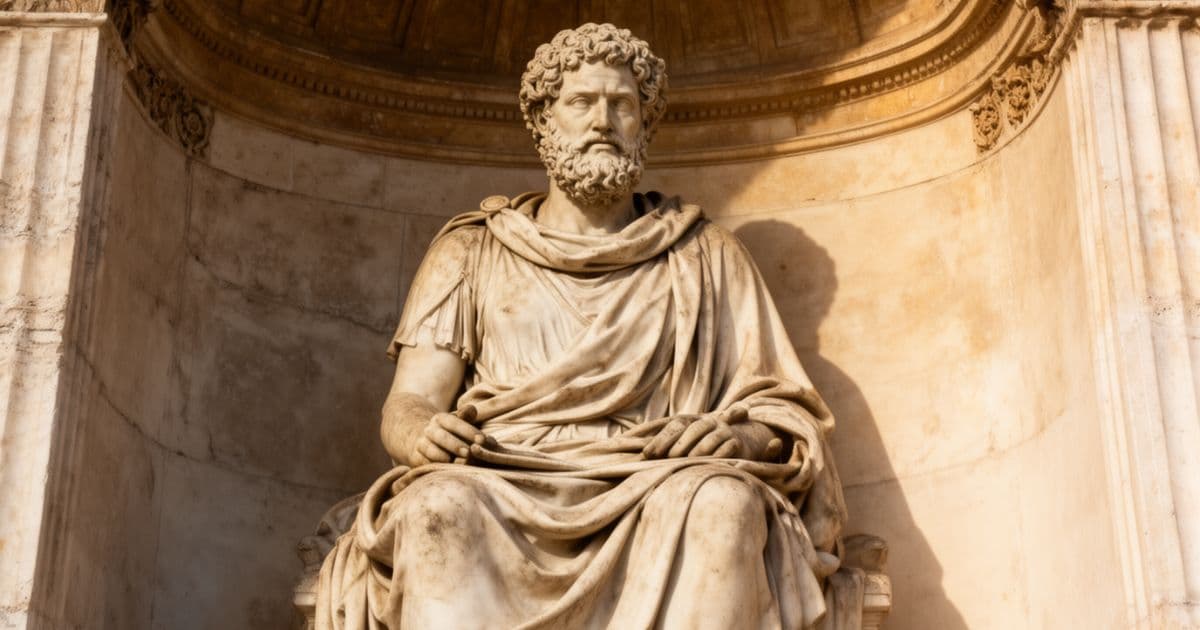
Meditations is one of the most unlikely books ever written — a private journal by the most powerful man in the world, never meant to be read by anyone else. Marcus Aurelius was Roman Emperor from 161 to 180 AD, commanding armies, presiding over a vast empire, and navigating court intrigue and endless war. Yet every night, he sat alone and wrote notes to himself — not about strategy or politics, but about how to be a better human being.
The journal spans twelve books, written mostly on military campaigns along the Danube frontier. The tone is relentlessly honest and often harsh. Marcus doesn't congratulate himself. He reminds himself not to be distracted, not to waste time, not to let flattery corrupt his judgment. He returns to the same themes again and again: that you control only your own mind, that external events are indifferent, that death comes for everyone regardless of rank or achievement.
At its core, Meditations is a manual for staying sane under pressure. Marcus draws heavily on the Stoic tradition — particularly Epictetus, a former slave — and applies it to a life of enormous responsibility. His central argument is that virtue is the only real good, and that inner peace comes from focusing on what you can control while accepting what you cannot.
What makes the book unusual is its intimacy. You are reading a man argue with himself, catch himself slipping, and start again. The writing is blunt, repetitive at times, and completely without vanity. It doesn't read like philosophy written for an audience — it reads like someone trying hard to live well, one day at a time.
Nearly two thousand years later, the struggles Marcus describes — distraction, ego, fear of death, the pressure to perform — feel entirely modern.
Essential Life Skills Deep Dive
Explore chapter-by-chapter breakdowns of the essential life skills taught in this classic novel.
The Dichotomy of Control
Some things are up to you, some are not — the Stoic foundation. The inner retreat, the judgment that creates disturbance, and how Marcus applied the principle to his own failures.
Memento Mori
Remember you will die — and how that thought, used deliberately, cuts through vanity, sharpens priorities, and gives genuine urgency to the present moment.
Other People Will Fail You
Marcus wakes expecting meddling, ungrateful, arrogant people — and that preparation is the point. The Stoic morning practice for dealing with human nature without being destroyed by it.
The Inner Citadel
The ruling faculty that circumstances cannot penetrate without your consent — built from what others gave you, maintained through daily self-examination, available at any moment.
Essential Skills
Life skills and patterns this book helps you develop—drawn from its themes and characters.
Critical Thinking Through Literature
Develop analytical skills by examining the complex themes and character motivations in Meditations, learning to question assumptions and see multiple perspectives.
Historical Context Understanding
Learn to place events and ideas within their historical context, understanding how Meditations reflects and responds to the issues of its time.
Empathy and Perspective-Taking
Build empathy by experiencing life through the eyes of characters from different times, backgrounds, and circumstances in Meditations.
Recognizing Timeless Human Nature
Understand that human nature remains constant across centuries, as Meditations reveals patterns of behavior and motivation that persist today.
Articulating Complex Ideas
Improve your ability to express nuanced thoughts and feelings by engaging with the sophisticated language and themes in Meditations.
Moral Reasoning and Ethics
Develop your ethical reasoning by grappling with the moral dilemmas and philosophical questions raised throughout Meditations.
Table of Contents
Lessons from Those Who Shaped Me
Marcus Aurelius opens his philosophical journal by doing something unexpected for a man with absolut...
Time Is Running Out
Marcus gets brutally honest about time and mortality. Writing from a military camp, he reminds himse...
Time, Beauty, and Mental Discipline
Marcus opens with a sobering reality check: your mind will not stay sharp forever. While your body m...
The Inner Fortress: Finding Peace Within
Marcus Aurelius reveals the central secret of Stoic inner peace: you do not need to escape anywhere ...
Getting Out of Bed and Living Your Purpose
Marcus starts with something we all know too well — that moment when the alarm goes off and you want...
The Art of Inner Control
Marcus Aurelius works through the fundamental Stoic principle that separates people who are controll...
The Universal Patterns of Human Experience
Marcus opens this chapter with a grounding observation: there is nothing new under the sun. The betr...
Mastering Your Inner Fortress
Marcus Aurelius is brutally honest about his own failures in this deeply personal chapter. He opens ...
Living in Harmony with Nature
Marcus opens with a stark claim: injustice is a form of impiety. The universe designed rational crea...
The Soul's Journey to Simplicity
In this deeply introspective chapter, Marcus turns his attention inward, addressing his own soul dir...
The Soul's True Powers
Marcus explores what makes the human soul genuinely unique. Unlike plants or animals, we can examine...
The Final Reflections
In his final book, Marcus brings together the threads he has been weaving for twelve volumes. He ope...
About Marcus Aurelius
Published 180
Marcus Aurelius (121-180 AD) was Roman Emperor from 161 to 180 AD, the last of the Five Good Emperors. A practitioner of Stoicism, he wrote his Meditations while on military campaigns, never intending them for publication.
Why This Author Matters Today
Marcus Aurelius's insights into human nature, social constraints, and the search for authenticity remain powerfully relevant. Their work helps us understand the timeless tensions between individual desire and social expectation, making them an essential guide for navigating modern life's complexities.
Amplified Classics is different.
not a sparknotes, nor a cliffnotes
This is a retelling. The story is still told—completely. You walk with the characters, feel what they feel, discover what they discover. The meaning arrives because you experienced it, not because someone explained a summary.
Read this, then read the original. The prose will illuminate—you'll notice what makes the author that author, because you're no longer fighting to follow the story.
Read the original first, then read this. Something will click. You'll want to go back.
Either way, the door opens inward.
Get the Full Book
Purchase the complete book to access all chapters and support classic literature
As an Amazon Associate, we earn a small commission from qualifying purchases at no additional cost to you.
Available in paperback, hardcover, and e-book formats
You Might Also Like




Free to read • No account required