
Themes in This Book
Click a theme to find more books with similar topics
What to expect ahead
What follows is a compact summary of each chapter in the book, designed to help you quickly grasp the core ideas while inviting you to continue into the full original text. Even when chapter text is presented here, these summaries are meant as a gateway to understanding, so your eventual reading of the complete book feels richer, deeper, and more fully appreciated.
The Republic
A Brief Description
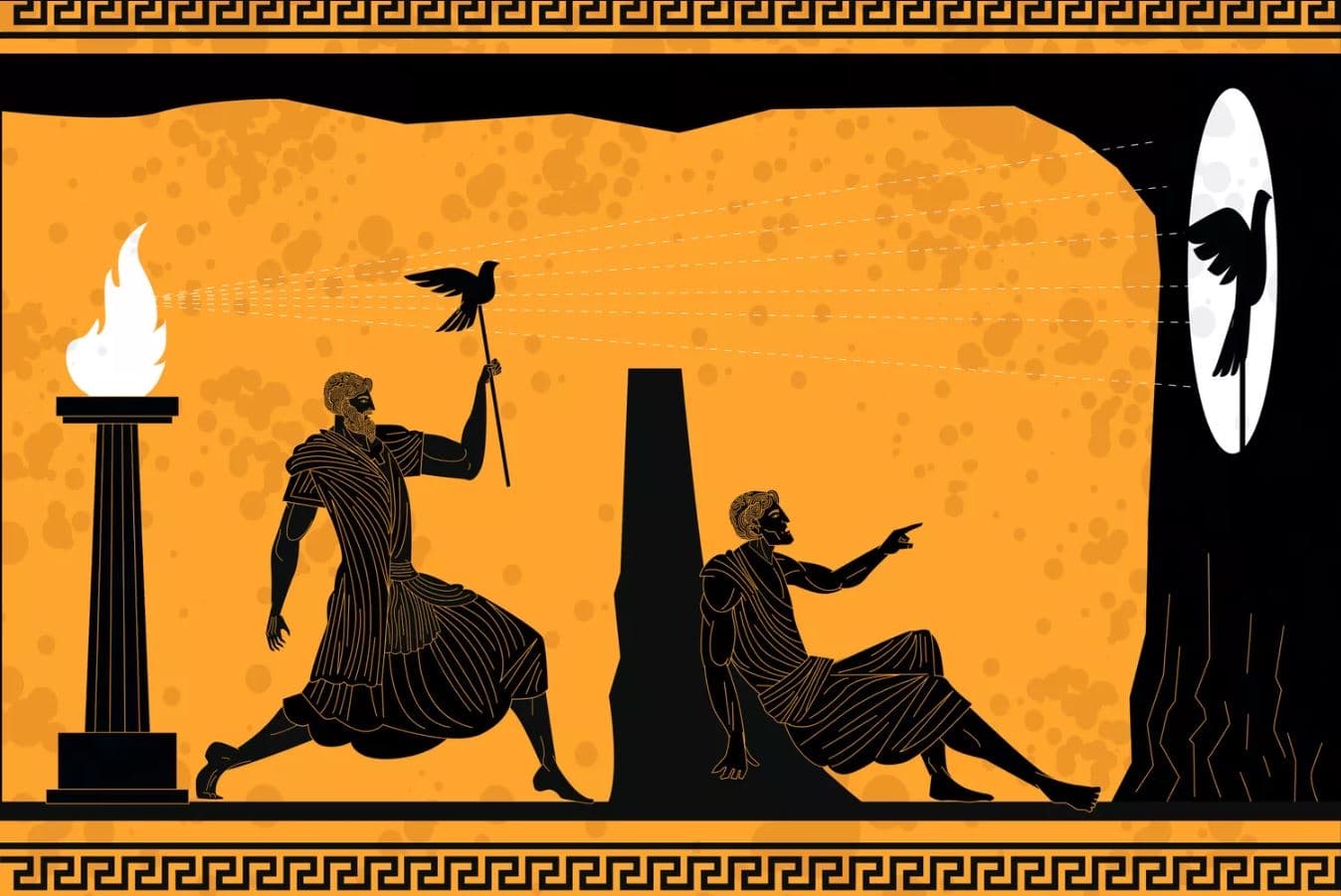
The Republic follows Socrates through a night-long conversation that begins with a simple question — what is justice? — and spirals into an ambitious exploration of reality itself. Plato constructs an imaginary city from the ground up, examining what makes a society good, who should lead it, and whether truth can be taught or only discovered. Along the way, he introduces ideas that still dominate Western thought: the Allegory of the Cave, where prisoners chained since birth mistake shadows for reality; the theory of Forms, which suggests everything we see is merely an imperfect copy of eternal templates; and the controversial claim that philosophers should be kings.
This isn't dry academic philosophy — it's Socrates at his most provocative, relentlessly questioning his companions until their confident answers collapse. He builds his ideal city brick by brick, assigns each class its role, designs an education system that shapes souls rather than just minds, and then — just when the city seems complete — watches it decay through five stages of corruption, each worse than the last. Tyranny, he argues, doesn't arrive by conquest. It grows from within, fed by the very freedoms that made the city feel good.
The Republic speaks to anyone who has wondered whether society could be better, questioned whether truth is objective or constructed, or felt the gap between how things are and how they should be. Plato forces uncomfortable questions: Can you handle the truth if it destroys your comfortable illusions? Should the wise govern the ignorant? Is your entire worldview built on shadows?
Written over 2,300 years ago, it remains startlingly relevant — because the questions it raises about justice, knowledge, and the good life have never been answered, only endlessly reconsidered by each generation that inherits them. You are now that generation.
Essential Life Skills Deep Dive
Explore chapter-by-chapter breakdowns of the essential life skills taught in this classic novel.
Why Be Good When You Could Get Away With It
The Ring of Gyges challenge — Glaucon's demand that Socrates prove justice is worth choosing for its own sake, and Plato's psychological answer through the portrait of the tyrant.
The Cave
What you think is real may not be — the Allegory of the Cave, the Ship of State, and the cost of turning around and looking at the fire instead of the shadows.
What Makes a Leader Worth Following
Why the people best suited to power are those who don't want it — the philosopher-king argument, the Ship of State, and why genuine competence loses to charisma in democratic conditions.
How Good People Become Bad Systems
Five stages of political degeneration — aristocracy to timocracy to oligarchy to democracy to tyranny — each driven by people pursuing real values beyond their proper limits.
Essential Skills
Life skills and patterns this book helps you develop—drawn from its themes and characters.
Critical Thinking Through Literature
Develop analytical skills by examining the complex themes and character motivations in The Republic, learning to question assumptions and see multiple perspectives.
Historical Context Understanding
Learn to place events and ideas within their historical context, understanding how The Republic reflects and responds to the issues of its time.
Empathy and Perspective-Taking
Build empathy by experiencing life through the eyes of characters from different times, backgrounds, and circumstances in The Republic.
Recognizing Timeless Human Nature
Understand that human nature remains constant across centuries, as The Republic reveals patterns of behavior and motivation that persist today.
Articulating Complex Ideas
Improve your ability to express nuanced thoughts and feelings by engaging with the sophisticated language and themes in The Republic.
Moral Reasoning and Ethics
Develop your ethical reasoning by grappling with the moral dilemmas and philosophical questions raised throughout The Republic.
Table of Contents
The Festival and the First Question
The Republic begins at a religious festival where Socrates and his friends are playfully detained by...
The Challenge of Justice
Glaucon and Adeimantus, two brothers, challenge Socrates with the toughest question yet: Why be just...
The Noble Lie and the Education of Guardians
Socrates continues designing the ideal state's education system, focusing on what stories and art sh...
The Soul's Three Parts
Socrates tackles a complaint that his ideal city makes its guardians miserable - they have no proper...
The Great Wave of Equality
Socrates drops a bombshell: women should be guardians too, trained exactly like men in war, athletic...
The Ship of Fools
Socrates faces a tough question: if philosophers are so wise, why do they have such terrible reputat...
The Cave and the Light
Plato presents his most famous image: people chained in a cave, watching shadows on a wall, believin...
The Decline of States and Souls
Plato traces the decline of governments through five stages, each worse than the last. Starting from...
The Tyrant's Prison
Plato reveals the tyrannical man as the ultimate cautionary tale - someone enslaved by his own desir...
The Immortal Soul and the Myth of Er
Plato closes The Republic with two final arguments: one about art, one about eternity. The attack o...
About Plato
Published -375
Plato (428-348 BC) was an Athenian philosopher, student of Socrates, and founder of the Academy in Athens. His dialogues have been used to teach philosophy, logic, ethics, and mathematics for over two millennia.
Why This Author Matters Today
Plato's insights into human nature, social constraints, and the search for authenticity remain powerfully relevant. Their work helps us understand the timeless tensions between individual desire and social expectation, making them an essential guide for navigating modern life's complexities.
Amplified Classics is different.
not a sparknotes, nor a cliffnotes
This is a retelling. The story is still told—completely. You walk with the characters, feel what they feel, discover what they discover. The meaning arrives because you experienced it, not because someone explained a summary.
Read this, then read the original. The prose will illuminate—you'll notice what makes the author that author, because you're no longer fighting to follow the story.
Read the original first, then read this. Something will click. You'll want to go back.
Either way, the door opens inward.
Get the Full Book
Purchase the complete book to access all chapters and support classic literature
As an Amazon Associate, we earn a small commission from qualifying purchases at no additional cost to you.
Available in paperback, hardcover, and e-book formats
You Might Also Like



Free to read • No account required