An excerpt from the original text.(complete · 3381 words)
[llustration]
As no objection was made to the young people’s engagement with their
aunt, and all Mr. Collins’s scruples of leaving Mr. and Mrs. Bennet for
a single evening during his visit were most steadily resisted, the coach
conveyed him and his five cousins at a suitable hour to Meryton; and the
girls had the pleasure of hearing, as they entered the drawing-room,
that Mr. Wickham had accepted their uncle’s invitation, and was then in
the house.
When this information was given, and they had all taken their seats, Mr.
Collins was at leisure to look around him and admire, and he was so much
struck with the size and furniture of the apartment, that he declared he
might almost have supposed himself in the small summer breakfast parlour
at Rosings; a comparison that did not at first convey much
gratification; but when Mrs. Philips understood from him what Rosings
was, and who was its proprietor, when she had listened to the
description of only one of Lady Catherine’s drawing-rooms, and found
that the chimney-piece alone had cost eight hundred pounds, she felt all
the force of the compliment, and would hardly have resented a comparison
with the housekeeper’s room.
In describing to her all the grandeur of Lady Catherine and her mansion,
with occasional digressions in praise of his own humble abode, and the
improvements it was receiving, he was happily employed until the
gentlemen joined them; and he found in Mrs. Philips a very attentive
listener, whose opinion of his consequence increased with what she
heard, and who was resolving to retail it all among her neighbours as
soon as she could. To the girls, who could not listen to their cousin,
and who had nothing to do but to wish for an instrument, and examine
their own indifferent imitations of china on the mantel-piece, the
interval of waiting appeared very long. It was over at last, however.
The gentlemen did approach: and when Mr. Wickham walked into the room,
Elizabeth felt that she had neither been seeing him before, nor thinking
of him since, with the smallest degree of unreasonable admiration. The
officers of the ----shire were in general a very creditable,
gentlemanlike set and the best of them were of the present party; but
Mr, Wickham was as far beyond them all in person, countenance, air, and
walk, as they were superior to the broad-faced stuffy uncle Philips,
breathing port wine, who followed them into the room.
[Illustration:
“The officers of the ----shire”
[Copyright 1894 by George Allen.]]
Mr. Wickham was the happy man towards whom almost every female eye was
turned, and Elizabeth was the happy woman by whom he finally seated
himself; and the agreeable manner in which he immediately fell into
conversation, though it was only on its being a wet night, and on the
probability of a rainy season, made her feel that the commonest,
dullest, most threadbare topic might be rendered interesting by the
skill of the speaker.
With such rivals for the notice of the fair as Mr. Wickham and the
officers, Mr. Collins seemed to sink into insignificance; to the young
ladies he certainly was nothing; but he had still at intervals a kind
listener in Mrs. Philips, and was, by her watchfulness, most abundantly
supplied with coffee and muffin.
When the card tables were placed, he had an opportunity of obliging her,
in return, by sitting down to whist.
“I know little of the game at present,” said he, “but I shall be glad to
improve myself; for in my situation of life----” Mrs. Philips was very
thankful for his compliance, but could not wait for his reason.
Mr. Wickham did not play at whist, and with ready delight was he
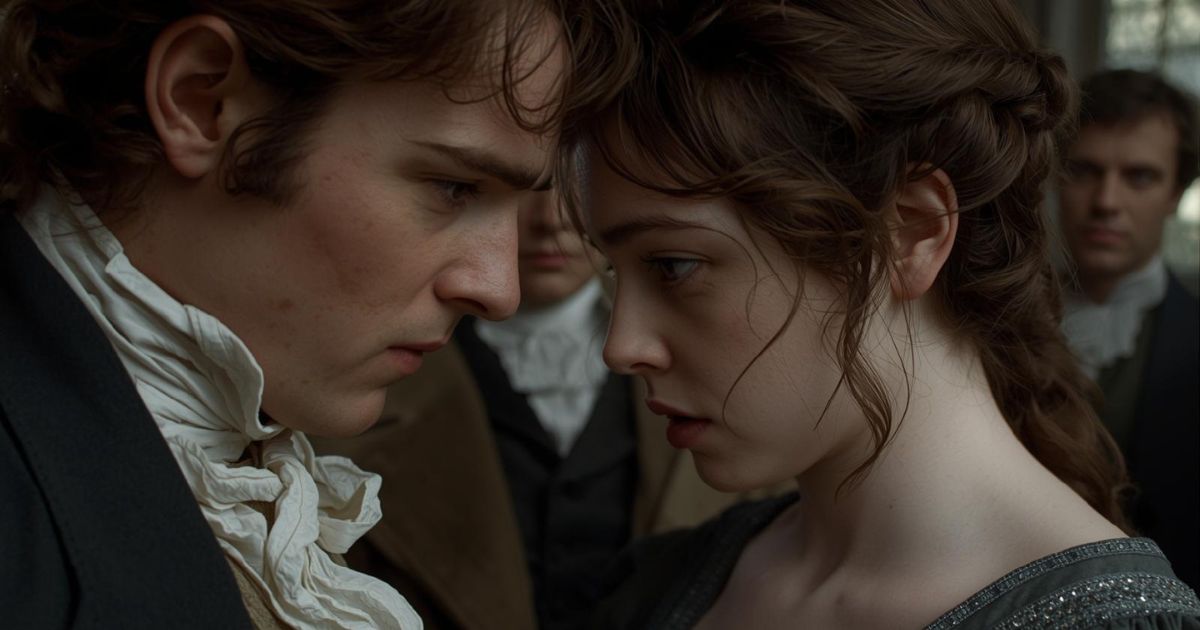
received at the other table between Elizabeth and Lydia. At first there
seemed danger of Lydia’s engrossing him entirely, for she was a most
determined talker; but being likewise extremely fond of lottery tickets,
she soon grew too much interested in the game, too eager in making bets
and exclaiming after prizes, to have attention for anyone in particular.
Allowing for the common demands of the game, Mr. Wickham was therefore
at leisure to talk to Elizabeth, and she was very willing to hear him,
though what she chiefly wished to hear she could not hope to be told,
the history of his acquaintance with Mr. Darcy. She dared not even
mention that gentleman. Her curiosity, however, was unexpectedly
relieved. Mr. Wickham began the subject himself. He inquired how far
Netherfield was from Meryton; and, after receiving her answer, asked in
a hesitating manner how long Mr. Darcy had been staying there.
“About a month,” said Elizabeth; and then, unwilling to let the subject
drop, added, “he is a man of very large property in Derbyshire, I
understand.”
“Yes,” replied Wickham; “his estate there is a noble one. A clear ten
thousand per annum. You could not have met with a person more capable of
giving you certain information on that head than myself--for I have been
connected with his family, in a particular manner, from my infancy.”
Elizabeth could not but look surprised.
“You may well be surprised, Miss Bennet, at such an assertion, after
seeing, as you probably might, the very cold manner of our meeting
yesterday. Are you much acquainted with Mr. Darcy?”
“As much as I ever wish to be,” cried Elizabeth, warmly. “I have spent
four days in the same house with him, and I think him very
disagreeable.”
“I have no right to give my opinion,” said Wickham, “as to his being
agreeable or otherwise. I am not qualified to form one. I have known him
too long and too well to be a fair judge. It is impossible for me to
be impartial. But I believe your opinion of him would in general
astonish--and, perhaps, you would not express it quite so strongly
anywhere else. Here you are in your own family.”
“Upon my word I say no more here than I might say in any house in the
neighbourhood, except Netherfield. He is not at all liked in
Hertfordshire. Everybody is disgusted with his pride. You will not find
him more favourably spoken of by anyone.”
“I cannot pretend to be sorry,” said Wickham, after a short
interruption, “that he or that any man should not be estimated beyond
their deserts; but with him I believe it does not often happen. The
world is blinded by his fortune and consequence, or frightened by his
high and imposing manners, and sees him only as he chooses to be seen.”
“I should take him, even on my slight acquaintance, to be an
ill-tempered man.”
Wickham only shook his head.
“I wonder,” said he, at the next opportunity of speaking, “whether he is
likely to be in this country much longer.”
“I do not at all know; but I heard nothing of his going away when I
was at Netherfield. I hope your plans in favour of the ----shire will
not be affected by his being in the neighbourhood.”
“Oh no--it is not for me to be driven away by Mr. Darcy. If he
wishes to avoid seeing me he must go. We are not on friendly terms,
and it always gives me pain to meet him, but I have no reason for
avoiding him but what I might proclaim to all the world--a sense of
very great ill-usage, and most painful regrets at his being what he is.
His father, Miss Bennet, the late Mr. Darcy, was one of the best men
that ever breathed, and the truest friend I ever had; and I can never be
in company with this Mr. Darcy without being grieved to the soul by a
thousand tender recollections. His behaviour to myself has been
scandalous; but I verily believe I could forgive him anything and
everything, rather than his disappointing the hopes and disgracing the
memory of his father.”
Elizabeth found the interest of the subject increase, and listened with
all her heart; but the delicacy of it prevented further inquiry.
Mr. Wickham began to speak on more general topics, Meryton, the
neighbourhood, the society, appearing highly pleased with all that he
had yet seen, and speaking of the latter, especially, with gentle but
very intelligible gallantry.
“It was the prospect of constant society, and good society,” he added,
“which was my chief inducement to enter the ----shire. I know it to be a
most respectable, agreeable corps; and my friend Denny tempted me
further by his account of their present quarters, and the very great
attentions and excellent acquaintance Meryton had procured them.
Society, I own, is necessary to me. I have been a disappointed man, and
my spirits will not bear solitude. I must have employment and society.
A military life is not what I was intended for, but circumstances have
now made it eligible. The church ought to have been my profession--I
was brought up for the church; and I should at this time have been in
possession of a most valuable living, had it pleased the gentleman we
were speaking of just now.”
“Indeed!”
“Yes--the late Mr. Darcy bequeathed me the next presentation of the best
living in his gift. He was my godfather, and excessively attached to me.
I cannot do justice to his kindness. He meant to provide for me amply,
and thought he had done it; but when the living fell, it was given
elsewhere.”
“Good heavens!” cried Elizabeth; “but how could that be? How could his
will be disregarded? Why did not you seek legal redress?”
“There was just such an informality in the terms of the bequest as to
give me no hope from law. A man of honour could not have doubted the
intention, but Mr. Darcy chose to doubt it--or to treat it as a merely
conditional recommendation, and to assert that I had forfeited all claim
to it by extravagance, imprudence, in short, anything or nothing.
Certain it is that the living became vacant two years ago, exactly as I
was of an age to hold it, and that it was given to another man; and no
less certain is it, that I cannot accuse myself of having really done
anything to deserve to lose it. I have a warm unguarded temper, and I
may perhaps have sometimes spoken my opinion of him, and to him, too
freely. I can recall nothing worse. But the fact is, that we are very
different sort of men, and that he hates me.”
“This is quite shocking! He deserves to be publicly disgraced.”
“Some time or other he will be--but it shall not be by me. Till I
can forget his father, I can never defy or expose him.”
Elizabeth honoured him for such feelings, and thought him handsomer than
ever as he expressed them.
“But what,” said she, after a pause, “can have been his motive? what can
have induced him to behave so cruelly?”
“A thorough, determined dislike of me--a dislike which I cannot but
attribute in some measure to jealousy. Had the late Mr. Darcy liked me
less, his son might have borne with me better; but his father’s uncommon
attachment to me irritated him, I believe, very early in life. He had
not a temper to bear the sort of competition in which we stood--the sort
of preference which was often given me.”
“I had not thought Mr. Darcy so bad as this--though I have never liked
him, I had not thought so very ill of him--I had supposed him to be
despising his fellow-creatures in general, but did not suspect him of
descending to such malicious revenge, such injustice, such inhumanity as
this!”
After a few minutes’ reflection, however, she continued, “I do
remember his boasting one day, at Netherfield, of the implacability of
his resentments, of his having an unforgiving temper. His disposition
must be dreadful.”
“I will not trust myself on the subject,” replied Wickham; “I can
hardly be just to him.”
Elizabeth was again deep in thought, and after a time exclaimed, “To
treat in such a manner the godson, the friend, the favourite of his
father!” She could have added, “A young man, too, like you, whose very
countenance may vouch for your being amiable.” But she contented herself
with--“And one, too, who had probably been his own companion from
childhood, connected together, as I think you said, in the closest
manner.”
“We were born in the same parish, within the same park; the greatest
part of our youth was passed together: inmates of the same house,
sharing the same amusements, objects of the same parental care. My
father began life in the profession which your uncle, Mr. Philips,
appears to do so much credit to; but he gave up everything to be of use
to the late Mr. Darcy, and devoted all his time to the care of the
Pemberley property. He was most highly esteemed by Mr. Darcy, a most
intimate, confidential friend. Mr. Darcy often acknowledged himself to
be under the greatest obligations to my father’s active superintendence;
and when, immediately before my father’s death, Mr. Darcy gave him a
voluntary promise of providing for me, I am convinced that he felt it
to be as much a debt of gratitude to him as of affection to myself.”
“How strange!” cried Elizabeth. “How abominable! I wonder that the very
pride of this Mr. Darcy has not made him just to you. If from no better
motive, that he should not have been too proud to be dishonest,--for
dishonesty I must call it.”
“It is wonderful,” replied Wickham; “for almost all his actions may be
traced to pride; and pride has often been his best friend. It has
connected him nearer with virtue than any other feeling. But we are none
of us consistent; and in his behaviour to me there were stronger
impulses even than pride.”
“Can such abominable pride as his have ever done him good?”
“Yes; it has often led him to be liberal and generous; to give his money
freely, to display hospitality, to assist his tenants, and relieve the
poor. Family pride, and filial pride, for he is very proud of what his
father was, have done this. Not to appear to disgrace his family, to
degenerate from the popular qualities, or lose the influence of the
Pemberley House, is a powerful motive. He has also brotherly pride,
which, with some brotherly affection, makes him a very kind and
careful guardian of his sister; and you will hear him generally cried up
as the most attentive and best of brothers.”
“What sort of a girl is Miss Darcy?”
He shook his head. “I wish I could call her amiable. It gives me pain to
speak ill of a Darcy; but she is too much like her brother,--very, very
proud. As a child, she was affectionate and pleasing, and extremely fond
of me; and I have devoted hours and hours to her amusement. But she is
nothing to me now. She is a handsome girl, about fifteen or sixteen,
and, I understand, highly accomplished. Since her father’s death her
home has been London, where a lady lives with her, and superintends her
education.”
After many pauses and many trials of other subjects, Elizabeth could not
help reverting once more to the first, and saying,--
“I am astonished at his intimacy with Mr. Bingley. How can Mr. Bingley,
who seems good-humour itself, and is, I really believe, truly amiable,
be in friendship with such a man? How can they suit each other? Do you
know Mr. Bingley?”
“Not at all.”
“He is a sweet-tempered, amiable, charming man. He cannot know what Mr.
Darcy is.”
“Probably not; but Mr. Darcy can please where he chooses. He does not
want abilities. He can be a conversible companion if he thinks it worth
his while. Among those who are at all his equals in consequence, he is a
very different man from what he is to the less prosperous. His pride
never deserts him; but with the rich he is liberal-minded, just,
sincere, rational, honourable, and, perhaps, agreeable,--allowing
something for fortune and figure.”
The whist party soon afterwards breaking up, the players gathered round
the other table, and Mr. Collins took his station between his cousin
Elizabeth and Mrs. Philips. The usual inquiries as to his success were
made by the latter. It had not been very great; he had lost every point;
but when Mrs. Philips began to express her concern thereupon, he assured
her, with much earnest gravity, that it was not of the least importance;
that he considered the money as a mere trifle, and begged she would not
make herself uneasy.
“I know very well, madam,” said he, “that when persons sit down to a
card table they must take their chance of these things,--and happily I
am not in such circumstances as to make five shillings any object. There
are, undoubtedly, many who could not say the same; but, thanks to Lady
Catherine de Bourgh, I am removed far beyond the necessity of regarding
little matters.”
Mr. Wickham’s attention was caught; and after observing Mr. Collins for
a few moments, he asked Elizabeth in a low voice whether her relations
were very intimately acquainted with the family of De Bourgh.
“Lady Catherine de Bourgh,” she replied, “has very lately given him a
living. I hardly know how Mr. Collins was first introduced to her
notice, but he certainly has not known her long.”
“You know of course that Lady Catherine de Bourgh and Lady Anne Darcy
were sisters; consequently that she is aunt to the present Mr. Darcy.”
“No, indeed, I did not. I knew nothing at all of Lady Catherine’s
connections. I never heard of her existence till the day before
yesterday.”
“Her daughter, Miss de Bourgh, will have a very large fortune, and it is
believed that she and her cousin will unite the two estates.”
This information made Elizabeth smile, as she thought of poor Miss
Bingley. Vain indeed must be all her attentions, vain and useless her
affection for his sister and her praise of himself, if he were already
self-destined to another.
“Mr. Collins,” said she, “speaks highly both of Lady Catherine and her
daughter; but, from some particulars that he has related of her
Ladyship, I suspect his gratitude misleads him; and that, in spite of
her being his patroness, she is an arrogant, conceited woman.”
“I believe her to be both in a great degree,” replied Wickham; “I have
not seen her for many years; but I very well remember that I never liked
her, and that her manners were dictatorial and insolent. She has the
reputation of being remarkably sensible and clever; but I rather believe
she derives part of her abilities from her rank and fortune, part from
her authoritative manner, and the rest from the pride of her nephew, who
chooses that everyone connected with him should have an understanding of
the first class.”
Elizabeth allowed that he had given a very rational account of it, and
they continued talking together with mutual satisfaction till supper put
an end to cards, and gave the rest of the ladies their share of Mr.
Wickham’s attentions. There could be no conversation in the noise of
Mrs. Philips’s supper party, but his manners recommended him to
everybody. Whatever he said, was said well; and whatever he did, done
gracefully. Elizabeth went away with her head full of him. She could
think of nothing but of Mr. Wickham, and of what he had told her, all
the way home; but there was not time for her even to mention his name as
they went, for neither Lydia nor Mr. Collins were once silent. Lydia
talked incessantly of lottery tickets, of the fish she had lost and the
fish she had won; and Mr. Collins, in describing the civility of Mr. and
Mrs. Philips, protesting that he did not in the least regard his losses
at whist, enumerating all the dishes at supper, and repeatedly fearing
that he crowded his cousins, had more to say than he could well manage
before the carriage stopped at Longbourn House.
[Illustration:
“delighted to see their dear friend again”
]
Master this chapter. Complete your experience
Purchase the complete book to access all chapters and support classic literature
As an Amazon Associate, we earn a small commission from qualifying purchases at no additional cost to you.
Available in paperback, hardcover, and e-book formats
Let's Analyse the Pattern
Why This Matters
Connect literature to life
This chapter teaches how manipulators use emotional validation and strategic restraint to make lies believable when they confirm our existing biases.
Now let's explore the literary elements.
Key Quotes & Analysis
"I have no right to give my opinion as to his being agreeable or otherwise. I am not qualified to form one. I have known him too long and too well to be a fair judge."
Context: Wickham pretends to be reluctant to criticize Darcy while actually setting up his attack
This is classic manipulation - Wickham appears modest and fair while actually preparing to destroy Darcy's character. He's making Elizabeth lean in to hear more by pretending he doesn't want to gossip.
"The late Mr. Darcy bequeathed me the next presentation of the best living in his gift. He was my godfather, and excessively attached to me."
Context: Wickham explains his supposed connection to the Darcy family
Wickham establishes his credibility by claiming a close family connection and a legal promise. This makes his story seem more legitimate and his grievance more personal and painful.
"I can never defy or expose him."
Context: Wickham explains why he won't publicly challenge Darcy
Wickham makes his inability to fight back seem noble rather than practical. In reality, he can't challenge Darcy because he lacks the social power and money, but he frames it as respect for Darcy's father.
Thematic Threads
Prejudice
In This Chapter
Elizabeth's existing dislike of Darcy makes her completely credulous toward Wickham's accusations
Development
Evolved from initial social prejudice to active confirmation bias seeking validation
In Your Life:
When have you let your existing dislike of someone make you instantly believe negative stories about them without questioning the source?
Deception
In This Chapter
Wickham uses charm, strategic details, and false restraint to manipulate Elizabeth's perceptions
Development
Introduced here as sophisticated emotional manipulation beyond simple lies
In Your Life:
How do you recognize when someone is using charm and selective details to manipulate your opinion of a third party?
Social Class
In This Chapter
Wickham frames his story around inheritance and social obligations that resonate with class anxieties
Development
Continues theme of how class dynamics create vulnerability to manipulation
In Your Life:
When has your anxiety about money, status, or belonging made you more susceptible to someone's misleading narrative?
Pride
In This Chapter
Elizabeth's intellectual pride makes her believe she's seeing through Darcy when she's actually being deceived
Development
Shows how pride in our judgment can blind us to manipulation
In Your Life:
Have you ever been so confident in your ability to 'read people' that you missed obvious red flags or manipulation?
Gender Roles
In This Chapter
Wickham presents himself as the honorable gentleman protecting a lady's reputation
Development
Uses social expectations of masculine honor to enhance his credibility
In Your Life:
How do you distinguish between someone genuinely standing up for what's right versus someone performing virtue to gain your trust?
You now have the context. Time to form your own thoughts.
Discussion Questions
- 1
What specific claims does Wickham make about Darcy, and how does he present himself in the story?
- 2
Why does Elizabeth believe Wickham so completely without asking for any proof or evidence?
- 3
Think of a time when someone told you exactly what you wanted to hear about a person you already disliked. How did that conversation make you feel?
- 4
If you were Elizabeth's friend, what questions would you encourage her to ask before accepting Wickham's story as truth?
- 5
What does this chapter reveal about how our existing opinions can make us vulnerable to manipulation?
Critical Thinking Exercise
Rewrite the Scene from Darcy's Perspective
Imagine you're Darcy and you somehow learn about this conversation between Elizabeth and Wickham. Write a short response explaining your side of the story about what really happened with Wickham. What evidence would you want Elizabeth to consider? How would you explain the situation differently while staying true to the facts?
Consider:
- •What might Darcy's father actually have intended, and how might circumstances have changed?
- •Consider what kind of person needs to borrow money from fellow officers and charms everyone immediately
- •Think about why someone might hint at scandalous details but refuse to share them - is that really noble restraint?
Coming Up Next...
Chapter 17
Elizabeth's world gets even more complicated when she returns home to find her family in chaos. Jane has received devastating news that will test everything the Bennet sisters thought they knew about love and loyalty.